Spending Cuts: Department of Education
Proposed Spending Cuts
by Chris Edwards
June 2009
The Department of Education should be closed and its programs terminated. The main activity of the department is providing grants to state and local governments, but channeling taxpayer dollars through Washington and then back to the states is an inefficient way to fund local activities such as education. It would be better if the states funded their own education programs free of all the paperwork that comes with federal aid.
Federal intervention into the primary and secondary schools has steadily increased since the 1960s, but there have been no obvious improvements in educational achievement. Indeed, standardized test scores for K-12 students have been stagnant for decades. Interestingly, Canada has virtually no federal involvement in its schools, but Canadian students generally score higher on international tests than do American students.
The sad truth is that rising control from Washington has probably damaged American schools by burying school administrators in regulations, reducing state flexibility, and retarding innovation. Federal involvement should be ended, and it should be up to the states, the schools, and parents to boost school performance. Cato scholars have proposed many ways to improve the schools.
Federal aid to college students should also be ended. Personal savings, financial institutions, and charitable organizations are more efficient funding sources for student loans and grants. Federal student aid has proven to be hugely wasteful, with large amounts of fraud and abuse combined with inept federal administration. A further problem is that rising federal aid has generated inflation in tuition and other educational costs. Thus, ending federal student subsidies would create beneficial pressure on colleges and universities to trim their bloated budgets and reduce their tuition.
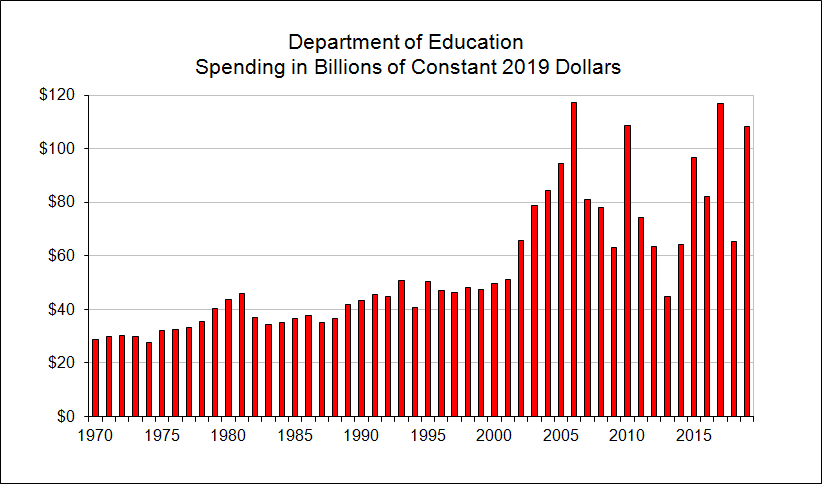
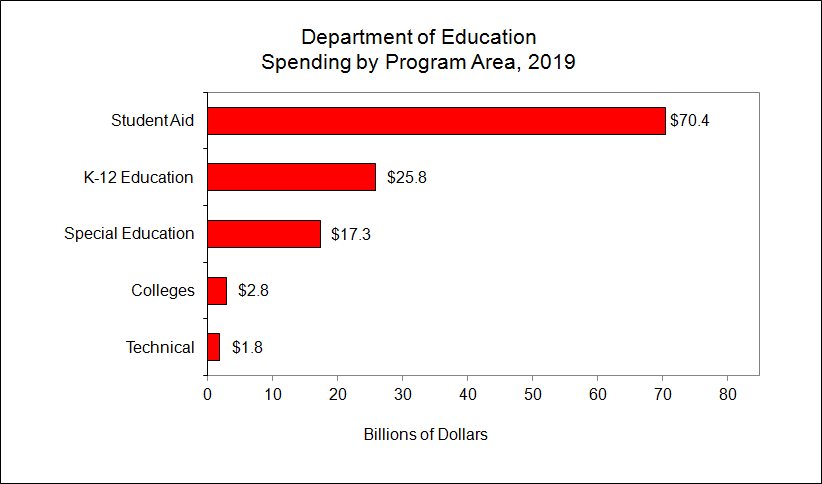
The table shows that taxpayers would save about $78 billion annually from closing down the department, or about $667 annually for every U.S. household.
| Department of Education | ||
| Proposed Spending Cuts | ||
|
Program
|
Spending in 2009
|
|
|
($ million)
|
||
| Elementary and Secondary Education | $28,071 | |
| Student Aid | $25,603 | |
| Special Education and Rehabilitation | $15,846 | |
| Postsecondary Education | $2,568 | |
| Vocational and Adult Education | $2,088 | |
| Innovation and Improvement | $1,086 | |
| English Language Acquisition | $883 | |
| Safe and Drug-Free Schools | $735 | |
| Education Sciences | $659 | |
| Departmental Management | $594 | |
| Other | $181 | |
| Total proposed cuts | $78,314 | |
| Total department outlays | $78,314 | |
| Source: Estimated fiscal year outlays from the Budget of the U.S. Government, FY2010. Student aid excludes a temporary spike in proprietary receipts. | ||